Laryngoscopes can be further sub-divided into two categories based on their illumination system: standard and fibre optic. Both illumination systems share similar light sources options.
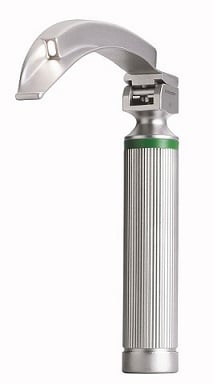
Standard laryngoscopes: Also known as conventional laryngoscope. A light bulb powered by an integral power supply is screwed into position, incorporated into the blade, at about 1/3 of the distance from the tip. Batteries are located within the handle.
Fibre optic laryngoscopes: In this system, the light is transmitted via a fibre optic bundle to a bulb housed within the handle. No heat is transmitted as opposed to the standard laryngoscope system’s integral power supply, eliminating the risk of burns. Another advantage of the fibre optic laryngoscope is the one-piece autoclaving. Batteries are located within the handle.
Note: standard and fibre optic designations refer solely to the difference in illumination system. A fibre optic laryngoscope can be rigid or flexible.
Laryngoscopes come with either a filament bulb (halogen, xenon) or a LED bulb.
Two ratings are typically used when describing a light source: the colour-rendering index and the Kelvin colour temperature scale.
In short, the higher the Kelvin rating, the whiter the light and the closer to 100 the CRI rating, the higher the quality of its colour compared to the light spectrum we can see thanks to the sun (natural daylight).
Filament vs LED
- Lighting: A more accurate pigmentation is made possible by the use of LED light due to its natural temperature colour. LED also provides more consistent light throughout the whole area being viewed.
- Lifetime: A LED bulb can last between 50,000-100,000 hours, more than 10x longer than an average filament bulb. This is 6-12 years of continuous use before needing replacement.
- Heat release: Filament bulbs produce a lot of heat (risk of burns or fire). LED bulbs are cool to the touch which makes them safer.
- Cost: Filament bulbs are cheaper to replace than LED bulbs. LED bulbs have a higher cost upfront but last exponentially longer and require less maintenance, making them a cheaper alternative over the long run.
-
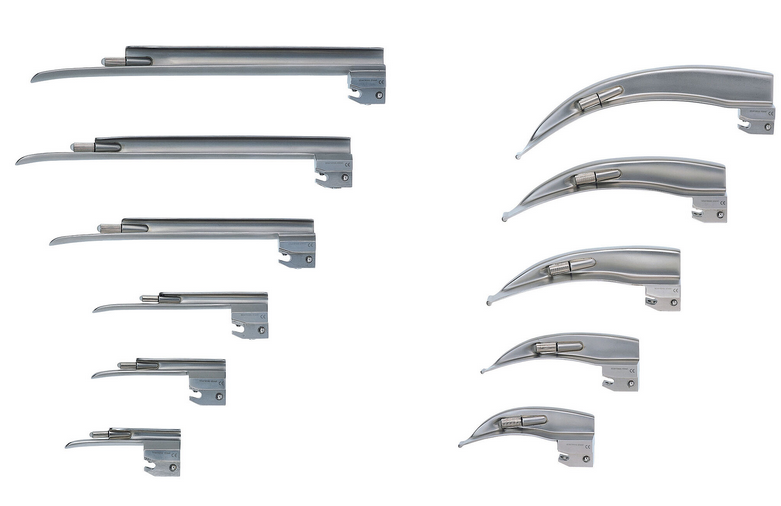
Straight: the most popular of this type is the Miller blade. It is rounded at the bottom and smaller at the tip with an extra curve two inches from the end to better lift the epiglottis by reaching beyond it. For difficult to intubate patients, this design facilitates intubation, offers a better visualization of the larynx and reduces dental trauma.
-
Curved: the Macintosh Laryngoscope Blade is the predominant model of this type. According to
Macintosh (1943), "this laryngoscope is designed to lessen the difficulty of exposing the larynx to pass an endotracheal tube. [...] The new laryngoscope is designed so that when its short curved blade is in position the tip will fit into the angle made by the epiglottis with the base of the tongue [...]; and a direct view thus obtained [...]. If the laryngoscope is now lifted the base of the tongue will be pushed upwards [...]; the epiglottis, because of its attachment to the base of the tongue, is drawn upwards and the larynx [...].". Macintosh blades are now available in a die-stamped format or one-piece construction format with a slightly larger flange.
Arino et al. (Canadian Journal of Anesthesia, 2003) recruited and randomized 500 patients for a study comparing direct laryngoscopy using five different laryngoscopes by a single operator and recommended the use of a curved blade to improve the ease of intubation as it provided more room for endotracheal tube manoeuvre inside the oropharynx. They added that ‘when laryngoscopy is difficult with the curved blade (the epiglottis obstructs the view of the larynx) the use of a straight blade may help to achieve adequate laryngeal visualization, but the ease of intubation may not improve.’ Nevertheless, the only consensus that exists regarding the choice of blade is that the operator’s familiarity with the equipment and experience manipulating it should be the over-riding deciding factor; ultimately, the most important aspect of any laryngoscopic intubation (performed without a gum elastic bougie) is the correct placement of the endotracheal tube.
Both types of blades can be made of metal (steel) or plastic. When deciding between reusable steel or disposable plastic, several factors need to be considered. Clinicians would refer to their national infection risk classification and if that came from the Center for Disease Control and Prevention (CDC), they would see that as tongue blades are considered intermediate or semi-critical risk due to the blade coming in contact with mucous membranes. This classification level requires a high-level disinfection. The handles on the other hand only comes in contact with skin, making it low risk or noncritical. Low-level disinfection is sufficient (e.g. a chemical cloth wipe in the operating room). Based on such considerations, a reusable handle and disposable laryngoscope blades would seem appealing if the cost of procuring disposable blades offset the costs of disinfection. However, this can only be true if the performance is equivalent.
The peer-reviewed literature contains several small studies demonstrating an inferior performance by the disposable plastic blades when compared to the reusable steel blades. This was due to an increased deformability, or flimsiness, making it harder to visualize the vocal cords. Other studies have been in the favour of disposable blades over reusable ones when assessing their respective performance, suggesting a lack of consensus among clinicians.