
Blood Pressure Learning Module
Rudolf Riester GmbH
Riester's blood pressure devices
Last edited: Jan. 8, 2021
Basics
At rest, a healthy heart beats between 60-80 times per minute thanks to the heart’s very own pacemaker, the sinoatrial node (SAN). The SAN generates the involuntary electric impulse responsible for contractions. During one heartbeat, the heart completes one cycle in which its chambers contract (systole) and relax (diastole) in sequence to pump blood. Blood pressure is a measure of the force that the heart uses to pump blood around the body. Pressure builds up when the ventricles are filled with blood and the valves are closed due to repeated contractions. The heart relies on such pressure control mechanisms to coordinate the opening and closure of the valves, thus the filling and ejection of blood in and out of the heart. While several factors can influence the pressure levels, it should remain within a healthy range to avoid physiological damage. It is measured in millimetres of mercury (mmHg) and is given in terms of systolic pressure (the pressure when the heart pushes blood out) over diastolic pressure (the pressure when the heart rests between beats). The UK’s National Health Service (NHS) states that:
- ideal blood pressure is considered to be between 90/60 mmHg and 120/80 mmHg
- high blood pressure is considered to be 140/90 mmHg or higher
- low blood pressure is considered to be 90/60 mmHg or lower

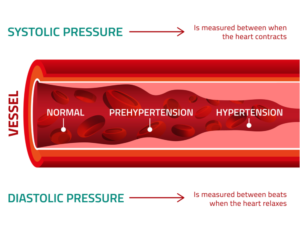
Blood Pressure Measurement
High blood pressure is a silent killer. It is a bigger risk factor than smoking, high blood sugar and obesity; in fact, it is the single biggest risk factor for all global disease with an associated cost of 1 trillion dollars over a 10-year period.
Blood pressure measurements are needed for long-term epidemiological studies, medical diagnosis, prevention and treatment of medical conditions and accuracy is of utmost importance. Devices for measuring blood pressure are called sphygmomanometers or blood pressure monitors.
There are two main methods to measure blood pressure:

Auscultatory method
Auscultatory method: a sphygmomanometer is used in combination with a stethoscope. When the cuff is inflated, the brachial artery becomes partially constricted and the blood flow becomes turbulent. As a result, the artery starts vibrating and produces sounds known as Korotkoff sounds. The pressure reading at the point at which the examiner starts to hear those sounds is marked as systolic pressure. When the sounds disappear, the pressure reading gives the diastolic pressure. This method can be used with manual or automatic inflation and deflation.
Oscillatory method
Oscillatory method: standard measurement method of automatic digital sphygmomanometers based on oscillations indicative of the blood volume. Blood pressure is estimated by sensors and algorithms which may vary between manufacturers and monitors. The blood pressure measurements are taken automatically and can be displayed on the monitor in less than a minute.
It is fairly common for people to be more tense than usual in a clinical setting, resulting in higher blood pressure readings in the clinic or hospital than at home (systolic pressure on average 10 mmHg higher and diastolic pressure about 5 mmHg higher). Arriving early to an appointment to have some time to relax and using the average mode of the monitor may help reduce this effect. Patients presenting a high blood pressure may be asked to measure their blood pressure at home or at a pharmacy to rule out the white coat effect.
White coat effect
It is fairly common for people to be more tense than usual in a clinical setting, resulting in higher blood pressure readings in the clinic or hospital than at home (systolic pressure on average 10 mmHg higher and diastolic pressure about 5 mmHg higher). Arriving early to an appointment to have some time to relax and using the average mode of the monitor may help reduce this effect. Patients presenting a high blood pressure may be asked to measure their blood pressure at home or at a pharmacy to rule out the white coat effect.
Mercury-based sphygmomanometer
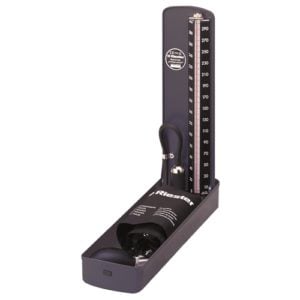
A mercury-based sphygmomanometer indicates blood pressure with a column of mercury. It consists of a manually inflatable cuff, air bladder, tubing, mercury gauge and a rubber bulb. When measuring blood pressure, it must be kept upright on a flat surface and the gauge must be read at eye level. No recalibration is necessary. The systolic and diastolic pressure readings are based on the sounds produced by the blood flowing inside the arteries (Korotkoff sounds). Auscultation with a mercury sphygmomanometer has been performed worldwide for more than a century and is still regarded as the most accurate and the gold standard method (especially for individuals with pulse irregularities), despite being phased out in some countries and clinical settings due to the health and environmental risks associated with mercury leakage and technological advances.
Aneroid sphygmomanometer
An aneroid sphygmomanometer does not contain mercury. It consists of a cuff, an in-built or attached stethoscope, a valve that inflates and deflates automatically and a gauge that can be read in any position. Like the mercury sphygmomanometer, readings must be based on Korotkoff sounds. Recalibration checks may be necessary due to the mechanism being sensitive to strain and shocks. Studies on non-shockproof aneroid sphygmomanometers have shown that only devices undergoing a regular (half-) yearly technical inspection (including recalibration) ensured a reliable measurement accuracy. When such procedure was lacking, up to 60% of devices demonstrated technical defects (especially portable instruments) or unacceptable measurement inaccuracy. A sphygmomanometer with the patented shock-proof® technology from Riester on the other hand is designed to sustain a fall of 120 cm (4ft) and still remain properly calibrated – an industry-leading performance that in turn translates into lower lifetime costs and an increased confidence that a high level of accuracy can be maintained over a longer period of time than traditional sphygmomanometers.
Automatic digital sphygmomanometer
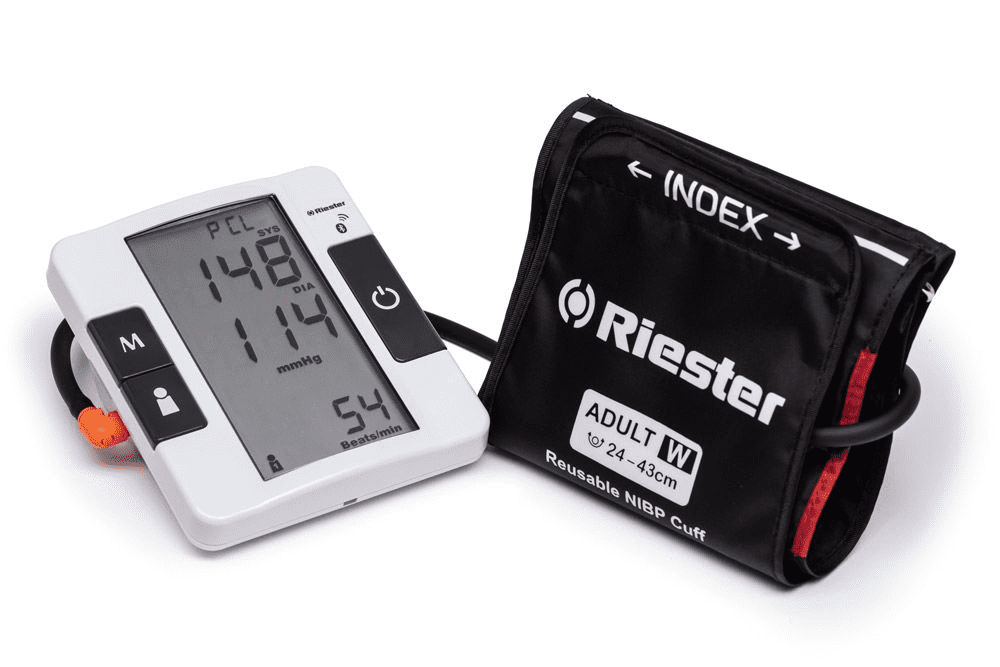
An automatic digital sphygmomanometer is powered by batteries or AC adapter. It is also mercury-free and employs oscillometric measurements, a microprocessor, electronic pressure sensors and calculations rather than auscultation. Like the two other types of sphygmomanometers, it includes an inflatable cuff. However it differs in its use of pressure sensors to evaluate and measure the oscillations of the arteries. Inflation can be manual or generated by a valve that automatically inflates and deflates. The reading is displayed digitally and a stethoscope is not required.
This type of blood pressure monitor is the most commonly found outside the clinical environment as it is simple to use and reasonably priced. The British Heart Foundation recommends using an upper cuff rather than a wrist or a finger cuff; using the right cuff size (there should be just enough space to slide two fingertips underneath the upper arm cuff); buying a BIHS-validated monitor; and making sure it is either serviced and calibrated or replaced every two years.
When purchasing a digital sphygmomanometer, it is important to verify that it has been clinically validated for relevant conditions as their calculations may otherwise not be correct in cases of arrhythmia, preeclampsia or arteriosclerosis, among others. Riester’s RBP-100 for example allows arrhythmia detection and is clinically validated for patients with special conditions: hypertension, hypotension, diabetes, pregnancy, pre-eclampsia, arteriosclerosis, end-stage renal disease and obesity.
| Mercury | Aneroid | Digital | |
| Compactness | - | +++ | +++ |
| Portability | + | +++ | +++ |
| Accuravy | +++ | ++ | + |
| Report generation | N/A | N/A | +++ |
| Memory | N/A | N/A | +++ |
| Ease of sue | + | + | +++ |
| recalibration | N/A | +++ | ++ |
| Cost | + | ++ (Cheapest) | - |
| Household self-use | N/A | + | ++ |
| Durability | +++ | ++ | ++ |
Appellations
“Clinically validated” means that the device was tested in a clinical trial by an independent party and the results reported were actual, statistically significant and able to pass the strict regulations that pertain to said device. A “clinically validated blood pressure monitor” such as Riester’s ri-champion® smartPRO/PRO+ for example would have been validated against international standards thus providing the user with peace of mind knowing that the monitor is suitable to accurately measure the blood pressure of all patient populations it is intended for, time and time again. It is a costly process because the process is very thorough and must be done by an independent party within a specific set of testing constraints and requirements. Some countries have requirements for periodical verifications to ensure that the required level of accuracy is maintained.
“Clinically tested” means that a product was tested in a clinical setting, period. It is much cheaper than clinical validation as the formalities required to validate a product against recognized standards using established protocols are not needed. We don’t know within which set of constraints it was tested and if the results mean anything. No certainty is offered that the unit can be tested again and still provide accurate and reliable results, and no certainty is offered that the unit can be calibrated once out of the factory.
“Clinically studied” means that someone looked at a product in a clinical setting. We don’t know that if we test it, it will produce accurate and reliable results, and we don’t know that we can calibrate it so that it keeps producing accurate and reliable results over its lifetime, if it did in the first place. This is the cheapest, and most deceptive way to get in the word “clinical” without needing to reveal results.
Works Cited
3 Types of Blood Pressure Monitoring Devices - Sphygmomanometers - Medicwiz
Addressing the global hypertension problem with wearable BP technology (valencell.com)
Blood Pressure and Mercury Sphygmomanometers (europa.eu)
Blood Pressure UK Cardiovascular Lab: Blood Pressure: Auscultatory Method (mcgill.ca)
Pumping action of your heart - Chest Heart & Stroke Scotland (chss.org.uk)